What Is Wrong with the New iPhone Update? Quick Fixes & Diagnostics
Experiencing issues after the latest iPhone update? This Update Bay troubleshooting guide covers common causes, quick fixes, and a step-by-step diagnostic flow to restore smooth performance.


What is wrong with the new iphone update? In most cases, the issue stems from software glitches, storage pressure, or background tasks slowing down the device. Start with a soft restart, free up space, and disable heavy apps from updating in the background. If problems persist, follow the diagnostic flow below.
Why the update can slow things down
After a major iPhone iOS update, it’s common to see short-term slowdowns as the system reindexes data, rebuilds caches, and optimizes new features like animations and privacy controls. According to Update Bay, these post-update performance hiccups are usually temporary and can be resolved with a few targeted checks. In some cases, users wonder what is wrong with the new iphone update, especially when apps drag or the home screen stutters. The good news is that most slowdowns are reversible with a small amount of system housekeeping and a quick round of checks. Keeping expectations realistic helps: these glitches typically ease within hours or a couple of days as the device settles into the new software.
Common culprits after updates
The most frequent causes include storage pressure from caches and media that haven’t been indexed yet, overwhelmed background tasks, and apps that aren’t yet optimized for the latest iOS. Another frequent factor is network-related settings that were reset during the update, causing slower app performance. Battery health also plays a role; reduced peak performance can throttle CPU cycles, making the device feel sluggish. Occasionally, a bug in the update itself causes temporary instability. Recognizing these culprits helps you methodically address the problem rather than guessing.
Quick checks you can do now
Before diving into deeper fixes, run through a handful of safe, quick checks. First, confirm there’s available storage by going to Settings > General > iPhone Storage and deleting or offloading unneeded files. Next, perform a soft restart or force restart to clear transient states. Make sure all apps are up to date in the App Store, and consider turning off Background App Refresh for non-essential apps. If you have low battery health indicated in Settings > Battery > Battery Health, consider charging habits and whether battery throttling could be contributing to the slowdown. These steps are low-risk and often yield immediate gains. Update Bay’s team recommends these quick wins as the first line of defense after an update.
Diagnostic flow: symptom → diagnosis → solutions
Symptoms can map to a few likely diagnoses. If apps freeze or the system feels unresponsive, the first diagnosis is storage pressure. If only certain apps underperform, the issue may be app-specific compatibility. Global slowdowns point toward a broader software hiccup. The recommended solutions are arranged from easy to harder, starting with freeing space, updating software, and ending with a potential restore if nothing else works. This workflow mirrors real-world troubleshooting and reduces the risk of data loss.
Step-by-step fixes for the most common cause
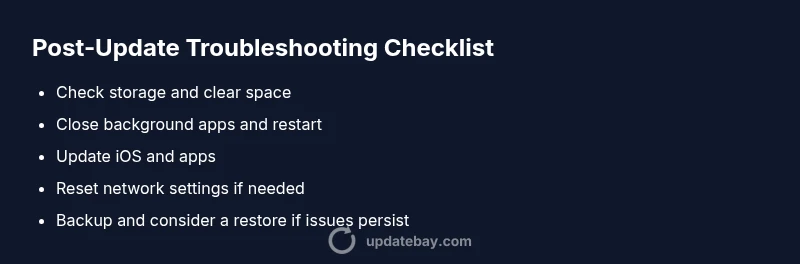
- Free up storage space: Remove large videos, old chats, and rarely used apps. Enable Offload Unused Apps to reclaim space automatically. 2) Force restart: Quickly press Volume Up, Volume Down, then hold the Side button until the Apple logo appears. 3) Update everything: Install the latest iOS and ensure third-party apps are current. 4) Reset network settings: This can fix slow app connectivity after an update. 5) Consider a clean restore: If the problem persists, back up, then restore via Finder/iTunes or iCloud, preferably after testing with a fresh install. 6) Reassess after fixes: Re-enable apps and observe performance for 24–48 hours. This sequence often restores normal speed without heavy disruption.
Safety, warnings, and best practices
Always back up before major changes like a restore. Do not erase your device without a recent backup. If you depend on your iPhone for work, consider staging a fix window outside critical hours. If data loss is a concern, rely on iCloud or computer backups. Avoid downloading unfamiliar tools to accelerate performance, as they can compromise security. Following a careful, incremental approach minimizes risk and keeps you in control.
How to prevent future slowdown after updates
Proactive maintenance helps prevent post-update slowdowns. Regularly review storage usage, keep apps updated, and disable nonessential background activities. Enable automatic updates for security patches and firmware improvements. Schedule periodic checks to confirm that your device is balancing performance with battery health and storage usage. A small routine now reduces bigger problems after the next release.
Steps
Estimated time: 60-90 minutes
- 1
Check storage and free space
Open Settings > General > iPhone Storage. Review what’s taking up space and delete or offload large apps, videos, and unused data. Use the Offload Unused Apps option to reclaim space without losing app data.
Tip: Tip: Move large media to iCloud or a computer to free local space quickly. - 2
Force restart
For iPhone 8 and newer, press Volume Up, then Volume Down, then hold the Side button until the Apple logo reappears. This clears temporary glitches without affecting data.
Tip: Tip: Do not force restart during a critical update install. - 3
Update iOS and apps
Go to Settings > General > Software Update to install the latest iOS. Open the App Store and update all installed apps. Updated software improves compatibility and performance.
Tip: Tip: If you’re on a beta or test build, consider reverting to the public release for stability. - 4
Reset network settings
Resetting network settings can fix slow app connectivity post-update. Go to Settings > General > Transfer or Reset iPhone > Reset > Reset Network Settings. You’ll need to reconnect to Wi‑Fi afterward.
Tip: Tip: Note your Wi‑Fi passwords before resetting. - 5
Consider a clean restore
If issues persist, back up your iPhone and perform a clean restore via Finder (macOS) or iTunes (Windows). This eliminates software conflicts and ensures a fresh start with the latest iOS.
Tip: Tip: After restore, gradually reinstall apps to identify the culprit if performance remains slow. - 6
Reassess and monitor
After completing fixes, monitor device performance for 24–48 hours. If slowdowns reappear, escalate to Apple Support or an authorized service provider.
Tip: Tip: Maintain a regular backup routine to simplify future recoveries.
Diagnosis: iPhone runs slow, apps lag, or the UI stutters after a software update
Possible Causes
- highStorage pressure from caches/media buildup
- mediumBackground tasks consuming CPU/RAM after update
- highSoftware glitch or compatibility issue in the update
- lowOutdated apps not optimized for the new OS
Fixes
- easyFree up storage and clear caches by removing large files and offloading apps
- easyForce restart to clear transient states
- easyUpdate iOS and all apps to latest versions
- mediumReset network settings or perform a controlled restore if necessary
Frequently Asked Questions
Why does my iPhone slow down after an update?
Updates can temporarily tax storage and processing as new features load. Background indexing and cache rebuilding can also cause slowdowns. Most devices recover within hours to a couple of days with proper maintenance.
Updates can slow your iPhone briefly as new features load; most devices recover within hours with proper maintenance.
How can I check how much storage I have left on my iPhone?
Open Settings, tap General, then iPhone Storage. You’ll see a breakdown of usage and recommendations to free space.
Open Settings > General to view your iPhone storage and optimize space.
Should I restore my iPhone to factory settings to fix updates?
A factory restore is a last resort. Back up first, then restore via Finder or iTunes. This clears persistent software issues but will erase data not backed up.
A factory restore is a last resort after backing up your data.
Will updating apps help with update-related slowdowns?
Yes. App updates include compatibility fixes for the latest iOS, which can reduce lag and improve stability after an update.
Updating apps helps with compatibility and stability after iOS updates.
When should I contact Apple Support?
If the issue persists after all standard fixes, there may be a hardware or deep software fault. Contact Apple Support or visit an Apple Store for a diagnostic.
If problems persist after fixes, contact Apple Support.
Can a device with poor battery performance affect update speed?
Yes. Battery health can throttle performance. If Health shows reduced capacity, addressing the battery can improve responsiveness.
Battery health can throttle performance after updates; consider service if necessary.
Watch Video
What to Remember
- Free up storage to restore responsiveness
- Keep iOS and apps up to date
- Follow a step-by-step diagnostic flow
- Back up before major fixes
- If unresolved, seek professional support