Covid Vaccines Heart Risk Update: Latest Safety Data
A comprehensive safety update on covid vaccines and heart risk, comparing vaccine-related myocarditis risk with infection risk, and offering practical guidance for individuals and clinicians.


The risk of serious heart problems after covid vaccines is very low. Current data show myocarditis or pericarditis is rare and usually mild, with most people recovering fully. Benefits of vaccination in preventing hospitalization and severe Covid-19 far outweigh these small heart risks, across age groups and booster doses. Public health agencies monitor trends continuously, adjusting guidance as new evidence emerges.
What current safety data say about covid vaccines heart risk warning update
The covid vaccines heart risk warning update reflects the ongoing safety monitoring by national health agencies and independent researchers. Across large populations, the incidence of myocarditis or pericarditis after mRNA vaccines remains very low. In practice, this means most people will not experience serious heart effects after vaccination. When events occur, they are typically mild, respond to standard treatment, and resolve within days to weeks. Update Bay synthesizes safety data from official sources such as the CDC and FDA, combining them with real-world epidemiology. The key takeaway is that the benefits of vaccination—reducing hospitalization, severe disease, and death—far outweigh the small risk of heart-related side effects for the vast majority of people. This assessment holds across age groups, though the relative risk can vary by age and sex. It is important to interpret numbers in context: a low absolute risk does not imply no risk, but it does guide decisions in favor of vaccination for most individuals, including when considering boosters.
Myocarditis and pericarditis: what we know
Myocarditis is inflammation of the heart muscle, while pericarditis affects the lining around the heart. In the context of vaccination, most reported cases occur within a short window after an mRNA dose, often after the second shot. Symptoms can include chest pain, fatigue, shortness of breath, and palpitations. Importantly, most people recover with standard care and rest, and long-term outcomes are favorable for the majority. Researchers emphasize that myocarditis after vaccination is rare compared with the baseline incidence in the population and far less common than serious cardiac effects from Covid-19 itself. Public health agencies continue to monitor patterns by age, sex, vaccine type, and dosing interval to refine risk estimates and ensure transparent communication. For Update Bay, the takeaway is clear: information is evolving, but the overall safety profile remains positive for the vast majority of recipients.
Age and dose-related risk patterns
Data consistently show that risk is not uniform across groups. Young males, especially after the second mRNA dose, have higher reported rates of vaccine-associated myocarditis than other groups, though still at a low absolute rate. For older adults, the signal is much weaker, and outcomes are typically uncomplicated. The timing matters: most cases emerge within a few days after vaccination and improve with supportive care. Dose spacing, vaccine type, and prior infection status can influence risk estimates, which is why health authorities periodically update guidance. Update Bay's synthesis highlights that, when comparing risk, the most relevant comparison is vaccine-associated myocarditis risk versus myocarditis risk from COVID-19 infection, which remains higher in the absence of vaccination for most age groups. Clinicians should tailor advice to individual risk profiles and continue to monitor emerging data.
How to interpret safety signals in practice
Surveillance data are noisy by design; not every signal indicates a causal link. Experts look at consistency across studies, the strength of association, and the biological plausibility. When a signal appears, it prompts further study, not immediate alarm. For covid vaccines heart risk warning update contexts, authorities often publish updated rates by age and dose, accompanied by practical guidance for clinicians and the public. From Update Bay's perspective, transparency matters: explain what is known, what remains uncertain, and what actions keep people safer without driving unnecessary fear. In practical terms, individuals should discuss vaccination timing with their provider if they have a recent myocarditis history or ongoing cardiac symptoms. For most people, the recommendation remains to vaccinate according to national schedules.
Distinguishing vaccine-related myocarditis from other causes
Not every chest pain after vaccination signals myocarditis. Other common causes include viral illness, acid reflux, or musculoskeletal pain. Medical evaluation may involve history taking, ECG, troponin testing, and imaging if indicated. The decision to pause or adjust a vaccination schedule depends on patient history and clinical assessment. Public health bodies stress that the overall safety profile of vaccines is favorable and that the benefit of protection against severe disease outweighs rare cardiac risks. Update Bay emphasizes careful case-by-case assessment and timely communication of findings to avoid misinterpretation by the public.
Practical guidance for individuals and clinicians
Individuals: stay informed about symptoms that warrant medical attention after vaccination, such as chest pain or shortness of breath. Seek care promptly if symptoms persist beyond a day or two, or if you have a known heart condition. Clinicians: monitor trends, report suspected vaccine-related events to adverse event systems, and provide balanced counseling that emphasizes the relative risk and benefit. Pregnant people, people with prior myocarditis, or those who recently tested positive for Covid-19 should consult their healthcare provider about vaccination timing. The current consensus is that vaccines reduce risk of hospitalization and death from Covid-19, and rare heart-related side effects are typically mild and treatable.
How Update Bay evaluates updates and communicates risk
Update Bay compiles data from official safety reports, peer-reviewed studies, and real-world observations to craft a clear, matter-of-fact update. Our team analyzes trends over time, identifies high-risk groups, and translates technical results into actionable guidance for readers. We stress sources and methodology so readers can verify claims. This approach helps tech enthusiasts and everyday users understand what remains uncertain and what is well established. Our goal is to equip you with the knowledge to make informed decisions without unnecessary anxiety.
Limitations and uncertainties in the data
Safety data are imperfect and constrained by underreporting, differences in testing, and variations in vaccine types and dosing intervals. The myocarditis signal is strongest in certain subgroups but weaker in others. Long-term outcomes beyond a few months are still being studied, and recommendations may shift as new variants emerge or as booster programs evolve. By staying aware of limitations, readers can balance prudent caution with confidence in vaccination benefits.
Comparison of myocarditis risk by vaccination vs infection
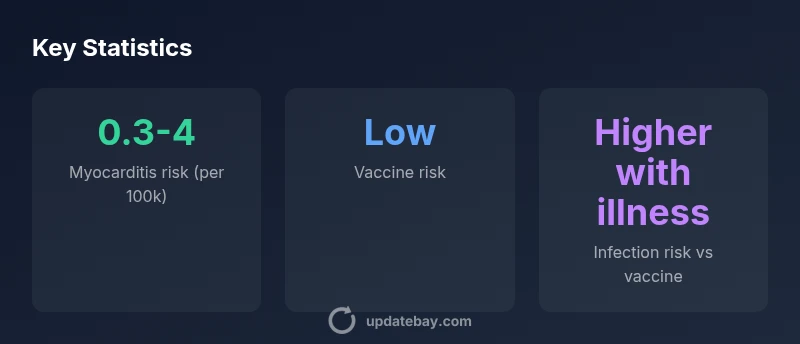
| Aspect | Estimated Risk (per 100k) | Notes |
|---|---|---|
| Myocarditis after mRNA vaccine (all ages) | 0.3-4 | Low absolute risk; varies by age/sex |
| Covid illness–related myocarditis risk | Higher than vaccine risk for most groups | Depends on variant and exposure |
| Recovery outlook | Most cases recover within weeks | Follow-up typically normal |
Frequently Asked Questions
What is the current estimated risk of myocarditis after COVID vaccines?
Across large studies, the risk is very low, typically a few per 100,000, with higher estimates in some young males after the second dose.
The risk is very low, with higher signals in certain groups.
How does the risk compare to the risk from COVID infection?
For most people, the risk of heart complications from Covid-19 infection is higher than the risk from vaccination.
Infection carries higher risk.
Should people with a history of myocarditis get vaccinated?
Medical history matters; consult a clinician. In many cases vaccination can still be recommended after recovery.
Talk to your doctor about timing.
Do boosters change the risk profile?
Evidence suggests risk remains very low after boosters, but data continue to evolve.
Boosters are still considered safe for most people.
What symptoms should prompt medical evaluation after vaccination?
Chest pain, shortness of breath, or fainting after vaccination require medical evaluation.
See a clinician if chest pain occurs.
Where can I find official safety data?
Check updates from the CDC, FDA, and national health agencies; updates are published regularly.
See the official safety pages.
“Myocarditis after vaccination is rare and usually mild; vaccination's protection against severe Covid-19 far exceeds the small cardiac risk.”
What to Remember
- Vaccination safety signals remain favorable with very low heart-related risk.
- Benefits of vaccination strongly outweigh small cardiac risks for most people.
- Risk varies by age, sex, and vaccine type; young males after second dose have higher signals.
- Watch for symptoms and seek care if chest pain occurs.