Difference Between Update and Patch in REST API
Explore the practical difference between update and patch in REST APIs, detailing PUT vs PATCH semantics, idempotence considerations, payload formats, and practical design guidance from Update Bay.


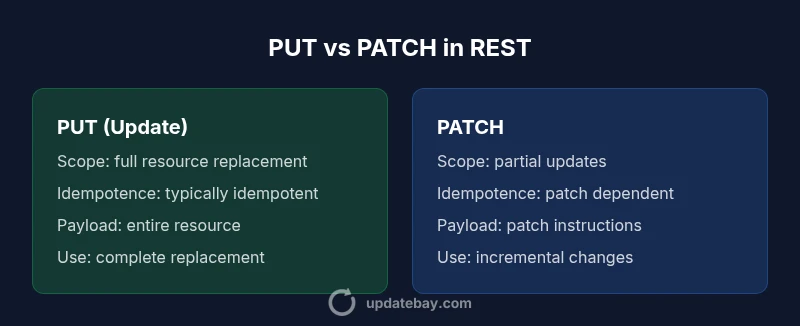
TL;DR: In REST APIs, update and patch describe how you modify resources, but they are not interchangeable. The most common distinction is that PUT (update) replaces the entire resource, while PATCH applies a partial modification. This quick comparison highlights their semantics, idempotence, payload formats, and practical guidance for API design and client usage.
Context: Why the difference matters in REST APIs
Understanding the difference between update and patch in REST API is essential for robust API design and reliable client behavior. When teams design an API, they must decide whether a request should replace the whole resource or modify only the changed fields. This choice impacts payload size, validation rules, error handling, and how clients synchronize state. According to Update Bay, a careful distinction reduces ambiguity for developers and improves interoperability across services. In practice, you’ll see two common patterns: a full replace using PUT (update) and a partial modification using PATCH. The rest of this article breaks down the nuances, offers concrete examples, and provides guidance for implementing these concepts consistently across stacks.
- The cost of a full replace can be higher in bandwidth and validation but ensures the resource matches the client’s representation exactly.
- Partial updates minimize payloads but require careful handling to avoid overwriting unintended fields.
Core concepts: idempotence, safety, and semantics
At the heart of REST design are concepts like idempotence, safety, and clear semantics. Idempotence means repeated identical requests should have the same effect as a single request; PUT is typically idempotent by construction, while PATCH’s idempotence depends on the exact patch being applied. Safety in REST is about whether a request changes server state; GET is safe, while PUT and PATCH are not inherently safe. The difference between update and patch in REST API becomes practical when you consider the shape of the payload: a PUT request usually carries the complete resource representation, while PATCH carries changes or a description of changes. When designing APIs, engineers should document the expected semantics, validation rules, and failure modes so clients know how to build reliable interactions.
HTTP methods overview: PUT, PATCH, and their expectations
HTTP defines methods with explicit semantics, but real-world APIs must translate those into domain-specific rules. PUT is the canonical method for a complete update: the payload represents the new state of the resource, and the server replaces the existing state with that representation. PATCH is designed for partial updates: it applies a delta or set of instructions to alter one or more fields without touching others. In practice, both methods require explicit contract: what fields are required, how nulls are treated, how versioning is managed, and what validation errors might be returned. A well-documented API should also specify whether PATCH uses a patch language (JSON Patch, JSON Merge Patch) or a domain-specific patch format.
- PUT often implies idempotent full replacement.
- PATCH supports partial changes, potentially non-idempotent depending on how it’s implemented.
Update vs Patch: Practical definitions and examples
In many REST APIs, the term update is closely aligned with PUT, though some teams use update to refer to any modification operation. A typical PUT request should replace the entire resource. Example:
PUT /users/123
Content-Type: application/json
{ "id": 123, "name": "Alex Doe", "email": "[email protected]", "roles": ["user"] }
If the server receives this payload, it replaces the current resource with the provided representation. PATCH, on the other hand, applies partial changes. You might send only the fields that need to change:
PATCH /users/123
Content-Type: application/json
{ "name": "Alexandra Doe" }
This example updates only the name, leaving other fields untouched. The exact semantics depend on the API contract, including whether null values reset fields or if omitted fields are preserved. The difference between update and patch in REST API becomes a practical design decision that affects consistency, validation, and client behavior.
Data formats for PATCH: JSON Patch, JSON Merge Patch, and custom formats
PATCH payloads can take multiple forms. The most widely used are JSON Patch and JSON Merge Patch. JSON Patch expresses a sequence of operations (add, remove, replace, move) to apply to the resource. JSON Merge Patch provides a simpler, declarative approach where the patch document itself is a partial resource; fields present in the patch replace the corresponding fields in the target resource. Example of JSON Patch:
PATCH /users/123
Content-Type: application/json-patch+json
[
  { "op": "replace", "path": "/name", "value": "Alex Doe" },
  { "op": "add", "path": "/roles/1", "value": "editor" }
]
Example of JSON Merge Patch:
PATCH /users/123
Content-Type: application/merge-patch+json
{ "name": "Alex Doe", "email": null }
Some APIs define their own patch formats; whatever you choose, document it clearly and ensure clients can generate patches deterministically. The difference between update and patch in REST API becomes a matter of selecting a patch strategy that aligns with your data model and validation approach.
Validation, error handling, and versioning considerations
Validation is central to both update and patch endpoints, but the scope differs. A PUT request must validate the entire resource against the schema; any missing required field or invalid value should result in a 400 or 422 error with detailed messages. A PATCH request validates only the fields present in the patch document, but you still need to ensure the resulting resource state satisfies business constraints. Versioning helps manage concurrent edits; consider optimistic locking (e.g., ETag headers) to prevent lost updates. If you allow partial updates, decide how to handle partial failures: do you return a partial success with a partial failure, or fail the entire operation? Clear error reporting and robust validation reduce ambiguity and improve client implementation. The difference between update and patch in REST API becomes a governance issue as well as a technical one—document semantics and enforce them at the API boundary.
Idempotence and side effects: what to expect
Idempotence is a key property to understand when comparing PUT vs PATCH. PUT is typically idempotent: sending the same payload repeatedly should yield the same resource state. PATCH’s idempotence depends on the patch definition; JSON Patch can be crafted to be idempotent, but not all operations guarantee it. Developers should design patches to be monotonic (repeatable with the same effect) where possible, and always consider the potential for cascading changes or side effects on related resources. Clients benefit from consistent semantics: a retry after a transient error should not introduce duplicate records or inconsistent data. In practice, combine clear contract definitions, versioning, and robust validation to minimize surprises.
- Prefer idempotent patch operations when possible.
- Use server-side guards to prevent partial updates from putting data in an invalid state.
Design patterns: when to choose PUT or PATCH in real-world APIs
The choice between PUT and PATCH should reflect your API’s data model and operational goals. Use PUT when you want to enforce a complete, normalized resource representation that clients can safely replace in one operation. Use PATCH for progressive improvements, small fixes, and situations where sending the entire resource would be wasteful. For complex domains, consider offering both:
- PUT for full resource replacement when a client is responsible for the entire state.
- PATCH for experimental features, incremental updates, or high-latency networks where bandwidth is at a premium.
Document the expected patch format, validation rules, and rollback strategy. The difference between update and patch in REST API becomes a guide for designing stable, scalable endpoints with predictable client behavior.
Security and authorization considerations
Authorization checks must be applied consistently for both PUT and PATCH endpoints. Ensure that the permissions required to modify a resource are clearly defined and checked before applying any changes. Input validation and sanitization are critical, especially for PATCH when embedded patch languages or deltas could be exploited if not properly constrained. Consider auditing and logging patch operations to support traceability and debugging. Use rate limiting and validation hooks to prevent abuse, and ensure that partial updates cannot bypass business rules. The difference between update and patch in REST API also impacts security posture: PATCH may expose more nuanced attack surfaces if patch formats allow complex operations; keep formats simple and auditable.
Migration and compatibility: evolving APIs safely
As APIs evolve, maintaining compatibility becomes important. If you introduce a new resource representation or deprecate fields, decide whether to support both PUT and PATCH for a transition period. You might gradually move clients toward a preferred approach by introducing feature flags, versioned endpoints, or deprecation notices. When clients depend on PATCH, ensure you provide clear guidance on supported patch formats and the impact of changes to resource schemas. The difference between update and patch in REST API informs your versioning strategy: treat PUT as a more rigid, versioned contract and PATCH as a more flexible, patch-driven path. Communicate changes clearly and minimize breaking changes to avoid widespread client churn.
Practical rules of thumb and checklist
- Define explicit semantics for PUT and PATCH in your API contract.
- Choose PUT for full replacements and PATCH for partial updates whenever possible.
- Document the payload shape, required fields, and validation rules for both methods.
- Decide on a patch format (JSON Patch or JSON Merge Patch) and implement it consistently.
- Implement idempotence where feasible, and use versioning/ETags for concurrency control.
- Provide comprehensive error messages and examples to help clients implement correctly.
- Include security considerations and auditability for all update paths.
These rules help ensure consistent behavior and reduce confusion across teams.
Implementing in common tech stacks: server examples
Most modern server frameworks offer straightforward support for both PUT and PATCH. In Node.js with Express, you might implement a PUT handler that replaces a resource entirely, validating the full payload before saving. A PATCH handler would apply a delta document (JSON Patch or Merge Patch) and then fetch the updated resource to validate the final state. Java frameworks often rely on JPA/Hibernate for full replacements and patch processing via libraries for JSON Patch or Merge Patch. In Python, frameworks like FastAPI or Django REST Framework provide decorators and serializers that help implement both patterns. Regardless of stack, keep the contract clear: what fields are required, how partial updates behave, and how errors are reported. The difference between update and patch in REST API should guide your implementation choices to deliver consistent, maintainable endpoints.
Getting started: step-by-step migration plan
If you’re migrating from a PUT-only API to support PATCH, start with a minimal, well-documented patch endpoint that accepts a common patch form (like JSON Merge Patch). Validate final state, and add a few representative examples. Gather client feedback, update API docs, and introduce versioning if needed. Phase in additional patch formats gradually, and retire old behavior only after clients have migrated. Throughout, ensure strict validation, clear error handling, and robust versioning. The difference between update and patch in REST API becomes a roadmap for incremental, safe evolution of your services.
Comparison
| Feature | PUT (update) | PATCH (patch) |
|---|---|---|
| Scope of change | Full-resource replacement | Partial updates to one or more fields |
| Idempotence | Typically idempotent by design | Depends on patch content; can be non-idempotent |
| Payload format | Represents the entire resource | Contains changes or patch instructions |
| Validation scope | Whole-resource validation on replace | Field-level validation on patch, plus final state validation |
| Best use case | Full state replacement when the client and server agree on the entire resource | Incremental updates to fix or adjust specific fields |
Positives
- Clear semantics for full resource replacement
- Supports strong validation and version consistency
- Predictable behavior under retries with PUT
- Efficient updates when only small parts change with PATCH
Downsides
- PUT can incur larger payloads
- PATCH requires careful handling of partial data
- Inconsistent PATCH support across services
- Misunderstandings about semantics can cause data loss
PUT is best for replacing an entire resource; PATCH is preferred for partial updates.
In practice, design APIs to favor PATCH for incremental changes and PUT for complete replacements, with clear contracts, robust validation, and consistent error handling. Update Bay recommends documenting semantics and providing example payloads to minimize client confusion.
Frequently Asked Questions
What is the difference between PUT and PATCH in REST APIs?
PUT replaces the entire resource, effectively overwriting the current state. PATCH applies partial updates, changing only the fields specified in the patch payload. The API contract should define exact semantics to avoid confusion.
PUT replaces the whole resource, PATCH updates only the specified fields. The API should clearly define patch semantics.
Is PATCH idempotent by default?
PATCH can be idempotent, but it depends on how the patch operations are defined. Some patch formats are inherently idempotent, while others may not be. Treat PATCH as potentially idempotent only when your patch language guarantees it.
Patch can be idempotent if you design it that way; verify your patch format.
When should I use PUT vs PATCH in API design?
Use PUT when you want to replace the full resource and maintain a strict contract. Use PATCH for incremental updates to reduce payloads and increase flexibility. Consider offering both where appropriate and document the expected behavior clearly.
Choose PUT for full replacements, PATCH for partial updates, and document the rules.
What formats can PATCH use?
PATCH can use formats like JSON Patch or JSON Merge Patch, or a custom domain-specific format. Each has its own syntax and semantics; pick one and document it for clients.
Common PATCH formats include JSON Patch and JSON Merge Patch; document your choice.
What security considerations apply to updates?
Apply consistent authorization checks for PUT and PATCH, validate input rigorously, and audit changes. Patch formats can introduce additional complexity; ensure patches are constrained and auditable.
Ensure proper authorization, validate inputs, and audit patch operations.
What to Remember
- Prefer PATCH for partial updates to minimize payloads
- Use PUT when the full resource state must be replaced
- Document patch formats and validation rules clearly
- Ensure idempotence where feasible and communicate semantics
- Support robust error handling and auditing for update paths
- Plan migrations with clear versioning and client guidance