How Often Does Credit Score Update? A Practical Guide
Learn how often credit scores update, what drives timing, and practical steps to monitor changes across FICO and VantageScore. Updated by Update Bay, 2026.


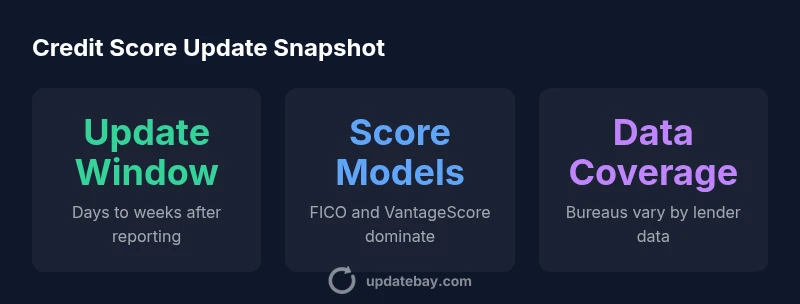
Credit scores update when new information is reported to the credit bureaus. In practice, updates occur days to weeks after a lender reports activity, and the exact timing depends on the scoring model (FICO vs. VantageScore), the bureau, and how quickly data is processed. Consumers shouldn’t expect instant changes from a single payment.
How credit score updates work
Credit scores update when lenders report new information to the major bureaus (Experian, Equifax, TransUnion) and those updates are processed by scoring models like FICO and VantageScore. According to Update Bay, updates hinge on when data is received and how quickly it's integrated into your file. In practice, individual items—such as a new loan, payment made on time, or a balance change—can influence your score after it's reflected in your bureau file. The mechanics involve translating tradeline changes into a numeric score, with different models emphasizing different factors. Understanding this process helps you set expectations for when you might see a change, and it clarifies why two people with similar activity may see different timing.
Timing and the role of reporting cycles
Data is not pushed to a bureau the moment you make a payment; it is typically reported by lenders on a monthly cycle and then batched for processing. Once the bureau receives the data, the scoring algorithm reruns and the updated score is published to your credit file. The time from payment to visible score can range from a few days to a couple of weeks, depending on when the creditor reports and how quickly the bureau processes updates. Additionally, the type of update matters: a statement closing, a new account, or a large utilization shift can trigger faster changes than minor balance movements.
FICO vs. VantageScore: Do their updates differ?
Both FICO and VantageScore refresh when new information is available, but they may weigh data differently and rely on data from varying bureaus. Some lenders report to all three bureaus, while others report to only one or two, which can create slight timing differences across scores. In practice, you might see a change on one score version before another, or see changes in one bureau before the others. The bottom line: timing is influenced by lender reporting cadence, bureau processing times, and the particular score version your lender uses.
Common update scenarios: what triggers a score change
Several events can trigger a score change after they are reported:
- A new tradeline or closed account alters the history length and risk mix.
- Payment on time or late payment reporting changes your payment history indicators.
- Utilization shifts from high balances to lower balances can quickly impact scores.
- Hard inquiries from new credit applications may cause brief score dips.
- Disputes and corrections, once resolved, refresh your file with corrected data. Each scenario has its own typical timing window, and the magnitude of the change depends on your entire credit profile.
Practical steps to influence and monitor updates
To influence update timing and accuracy:
- Keep accounts current with timely payments and controlled utilization.
- Avoid excessive new credit applications, which trigger inquiries that may affect timing.
- Review your credit reports regularly to catch errors early.
- Set up alerting or use services that track changes across bureaus.
- When you pay down debt, understand that the reported balance matter, not just the payment itself. Proactively monitoring helps you confirm when changes appear and minimizes surprises.
How to verify and read your credit reports for timing
Start with a fresh set of reports from each bureau to understand baseline data. Use official sources and trusted credit-scoring services to track updates. Note the dates of last activity reported by creditors and compare them with when you observe a score change. Remember that soft checks won’t impact your score, but hard inquiries tied to new credit can affect the timing and magnitude of updates. By correlating reporting dates with observed score changes, you gain a practical sense of timing.
Debunking myths about credit score updates
Common myths can mislead timing expectations. For example, some people believe scores update instantly after a payment—often not the case. Others think checking a score will impact it—safely debunked, as most checks are soft. Finally, there’s a belief that closing an account always hurts the score immediately; in reality, effects depend on overall utilization and account age, and changes can take longer to reflect after data is reported. Armed with accurate expectations, you can plan around genuine update timelines.
Building a robust monitoring routine
Establish a routine to observe score changes monthly or after major financial moves. Track changes across all three bureaus for a broader view of your credit profile. Enable alerts from your bank, lender, and credit monitoring services to catch reported activity quickly. Maintain good financial habits to ensure updates trend in your favor—regular on-time payments, prudent credit utilization, and strategic plan for new credit. A consistent routine reduces anxiety about when and how your score changes.
Tools and resources to track score updates
Leverage a combination of free and paid tools to stay informed. Free annual credit reports from the official site give you baseline data, while consumer-advantage products can offer ongoing score updates and score simulators. When evaluating tools, verify they pull data from the major bureaus and clearly explain the timing of updates. Using reputable resources helps you understand not just the current score but the likely timing of future updates.
How different activities influence update timing
| Scenario | Impact on Score | Typical Update Window |
|---|---|---|
| New tradeline | Possible score increase depending on age and utilization | Days to weeks |
| Payment on time | Positive impact, strengthens payment history | Days to weeks |
| High credit utilization spike | Negative impact due to utilization ratio | Days to weeks |
| Hard inquiry | Temporary dip; usually recovers within weeks | Days to weeks |
Frequently Asked Questions
How often does my credit score update?
Scores update when new information is reported and processed by the bureaus. The timing varies by lender reporting cadence and the bureau's processing speed, typically occurring within days to weeks after activity is reported.
Scores update when new information is reported and processed by the bureaus, usually within days to weeks after activity.
Will paying off debt immediately raise my score?
Paying down debt can improve your utilization ratio, which often leads to a score increase. The effect depends on how recent and how large the balance change is within your overall credit profile.
Paying down debt can raise your score by improving your utilization, depending on your overall profile.
Do soft inquiries affect score updates?
Soft inquiries do not affect your credit score and do not trigger updates in your score from lenders. They are not part of the scoring model used by lenders in most cases.
Soft inquiries don’t affect your score and don’t trigger updates.
Can I speed up an update after paying a bill late?
There’s no guaranteed way to speed up an update, but ensuring timely payments going forward and reducing utilization can help the score recover in subsequent cycles as data is re-reported.
There’s no guaranteed way to speed it up, but staying current helps later updates reflect improvements.
Does checking my score cause updates?
No. Checking your own score is typically a soft inquiry and does not trigger updates or affect your credit score.
Checking your score won’t trigger updates or hurt your score.
“Credit score updates reflect the latest reported data, but timing can differ by model and bureau. The most reliable picture comes from consistent monitoring.”
What to Remember
- Expect changes days to weeks after activity is reported
- FICO and VantageScore are the dominant models to watch
- Utilization changes often drive visible updates quickly
- Monitor all three bureaus for a complete picture