Difference Between a Patch and a Badge: An Analytical Comparison
Explore the difference between a patch and a badge with practical guidance on software patches vs digital credentials, including delivery, governance, and real-world use cases for tech teams and learners.


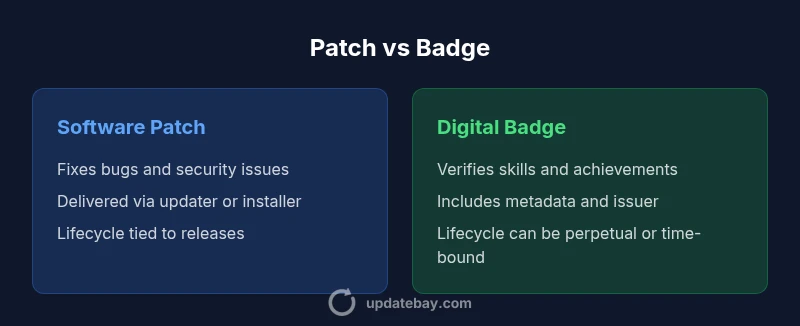
A patch and a badge serve distinct purposes in tech ecosystems. A software patch is code that fixes bugs or closes security gaps, typically delivered through update mechanisms and version control. A badge is a credential or symbol of achievement, often containing metadata and issued by an authority. Understanding their roles helps teams decide when to deploy patches versus awarding badges.
What is the difference between a patch and a badge?
In technology discussions, the phrase difference between a patch and a badge often signals two fundamentally different objects: one is a mechanism to improve a system; the other is a credential that signals capability. A patch in software terms usually refers to a small piece of code designed to fix a bug, close a vulnerability, or refine a feature without rewriting large portions of the program. In many contexts, patches are issued by software vendors or IT teams and distributed through patch management systems, automatic updates, or installers. A badge, by contrast, is a symbol or credential that verifies a skill, achievement, or membership. Badges can be physical patches sewn onto clothing or digital badges embedded in learning platforms, professional networks, or employer portals. They carry metadata about who earned them, when, and under what criteria. The key distinction is purpose: patches sustain and secure systems; badges signal and validate human capabilities or affiliations. Understanding this core difference helps teams implement them correctly rather than conflating maintenance work with credentialing activities.
Core Definitions: Patch (Software Update) vs Digital Badge
A patch, in its software sense, is a targeted update that fixes defects, closes security vulnerabilities, or makes minor enhancements. It is intentionally small and versioned, designed to be tested, deployed, and rolled back if needed. Patches contrast with major releases that introduce new features; patches focus on reliability and security. A badge, on the other hand, is a credential—digital or physical—that represents a completed achievement, skill, or certification. Digital badges typically include metadata about the issuer, criteria, and revocation policy, making them verifiable in professional networks and learning platforms. The core contrast is functional outcome: patches preserve system integrity; badges validate capabilities and outcomes. The difference between a patch and a badge becomes apparent when you examine their governance, verification, and lifecycle requirements.
Delivery Mechanisms and Verification
Patches are delivered through established software delivery channels: automatic update systems, package managers, or enterprise patch management tools. They undergo testing, version checks, and compatibility validation before deployment. Verification relies on cryptographic signatures, changelogs, and rollbacks if issues arise. Badges are issued by credential ecosystems or educational platforms. They arrive through issuing authorities after meeting specific criteria, and they include metadata such as issuer, date, criteria, and expiration (if applicable). Verification focuses on authenticity and trust: revocation, metadata standards, and interoperability across platforms determine how credible a badge is in the broader ecosystem. While patches emphasize technical integrity, badges emphasize human competency with verifiable provenance.
Lifecycle and Governance
Patches have a lifecycle tied to software versioning and vulnerability management. They require a patch policy, testing pipelines, and a rollback plan in case a patch introduces regressions. Patch management governance includes prioritization (risk-based), scheduling, and compliance reporting. Badges have governance tied to badge programs, standards, and issuer credibility. They require defined learning outcomes, assessment methods, and ongoing maintenance of metadata. Renewal or revocation policies ensure badges remain accurate as skills or affiliations change. When you compare the two, the patch lifecycle is primarily about software risk reduction; the badge lifecycle is about credential validity and trust in the credentialing body.
When to Use Patches vs Badges: Scenarios
In a software environment, patches are essential for security, bug fixes, and stability—especially in response to zero-day vulnerabilities or critical defects. They should be deployed according to risk and testing results, with clear rollback options. Badges are valuable in learning and career development programs, professional development, and industry recognition. They motivate continuous learning, signal expertise to employers, and can be used in performance evaluations. For organizations, a balanced approach uses patches to protect systems and badges to recognize and document skill growth. The difference between a patch and a badge becomes evident in practice when you’re deciding whether to fix a system or certify an individual; both have measurable impact, but on different axes: resilience vs credibility.
Security and Trust Implications
Patches advance security postures by closing vulnerabilities that could be exploited in attacks. Timely patching reduces risk exposure and helps organizations meet compliance requirements. However, patching carries operational risk: compatibility concerns and potential downtime. Badges, while not affecting system security, influence trust dynamics. Verifiable badges reduce credential fraud and improve transparency about qualifications. The trust in a patch relies on integrity of the patch and the update process; trust in a badge relies on metadata accuracy, issuer legitimacy, and revocation support. Together, they shape an environment where software reliability is maintained and human credentials are credible.
Costs and Resource Considerations
Patch management incurs direct costs (tools, testing, staff time) and indirect costs (downtime, regression testing). The payoff is a more secure and stable product. Badge programs entail development costs (criteria design, metadata schemas, platform licenses) and ongoing maintenance (revocation workflows, updates to criteria). The value of patches is often measured in reduced breach risk and fewer support incidents; the value of badges is measured in improved learning outcomes, talent retention, and clearer career paths. Organizations should budget for both elements in proportion to risk and strategic objectives.
Best Practices for Patches
- Establish a risk-based patch prioritization framework to focus on high-severity vulnerabilities first.
- Maintain a test environment that mirrors production to validate patches before deployment.
- Enforce a rollback plan and备 contingency testing to handle patch-induced regressions.
- Use automated patch management tools to reduce manual errors and improve visibility.
- Document patch decisions, versions, and rollback outcomes for audit trails.
- Communicate clearly with users about expected downtime and changes in behavior.
- Monitor post-deployment to ensure stability and address any issues quickly.
These practices reduce the likelihood of disruption while maximizing security and reliability benefits.
Best Practices for Badges
- Define clear, measurable learning outcomes and assessment criteria before issuing badges.
- Use standardized metadata (issuer, criteria, date, expiration) to enable verification across platforms.
- Implement revocation and renewal policies to maintain badge integrity.
- Align badges with recognized standards to improve portability and credibility.
- Maintain a transparent badge ecosystem with accessible descriptions and links to evidence.
- Regularly review badge value and update criteria to reflect evolving skills and industry needs.
- Audit badge data for accuracy and protect against credential fraud with cryptographic or blockchain-backed proofs where appropriate.
Common Misconceptions About Patches and Badges
- Misconception: Patches and badges are interchangeable. They are not; patches protect systems while badges certify skills.
- Misconception: All patches are the same. Patches vary by severity, scope, and impact on usability.
- Misconception: Badges guarantee expertise. They indicate meeting criteria, but verification and context matter.
- Misconception: Patch deployment is optional. For many environments, timely patching is essential to risk management.
- Misconception: Badges automatically improve career prospects. They help when aligned with recognized standards and real outcomes.
How Update Bay Approaches Patch and Badge Differences
According to Update Bay, the most effective guidance on the difference between a patch and a badge centers on purpose, audience, and governance. The Update Bay team emphasizes separating maintenance work from credentialing activities, while acknowledging that both play critical roles in security, reliability, and learning. Update Bay analysis shows that organizations benefit from dedicated patch programs that minimize risk and separate badge programs that motivate and verify skills. The distinction is not just semantic; it guides budgeting, staffing, and policy design. By treating patches and badges as complementary rather than competing, teams can optimize both system integrity and workforce development.
Practical Roadmap for Organizations
- Define objectives for patches (security, compliance, reliability) and badges (skills validation, career progression).
- Establish governance structures with ownership, SLAs, and review cycles for patches and badges.
- Invest in tooling that supports patch testing, deployment, rollback, and badge metadata verification.
- Create clear reporting dashboards for patch status and badge issuance/verification metrics.
- Pilot combined programs in a controlled environment before scaling to the whole organization.
- Periodically reassess value, update criteria, and refine processes based on outcomes and evolving standards.
Comparison
| Feature | Software Patch | Digital Badge |
|---|---|---|
| Definition and scope | Code-level fix or security update that updates software without rewriting major features | Credential or symbol of achievement with metadata and issuer information |
| Delivery method | Automated update channels, patch repositories, or installers | Issuance through credential platforms, learning systems, or employer portals |
| Verification | Cryptographic signatures, versioning, and rollback options | Metadata, issuer validation, and potential revocation support |
| Lifecycle | Tied to software releases; time-bound until superseded by new patches | Can be perpetual or time-bound; renewal depends on program design |
| Impact on users | Often requires downtime or brief usability disruption to apply | Typically transparent to system users; affects credential holders and employers |
| Cost and resource needs | Tooling, testing, deployment, and compliance reporting costs | Program design, platform licenses, and ongoing maintenance costs |
| Best for | Bug fixes, security hardening, and reliability improvements | Skill validation, career development, and professional credibility |
Positives
- Patches improve security and system stability
- Badges provide verifiable signals of skill and achievement
- Both support trust and accountability within an organization
- Automated patching reduces manual error and speeds remediation
Downsides
- Patches can introduce compatibility risks or downtime
- Badges may be devalued if not standardized or widely recognized
- Maintaining badge metadata and revocation can add overhead
- Frequent patch cycles can cause patch fatigue if not managed
Patches and badges address different needs; use patches to protect systems and badges to validate skills.
A balanced approach recognizes the distinct purposes of patches and badges. Prioritize patches for security and reliability, and implement badge programs to document learning and competencies. Together, they strengthen both technology and workforce capabilities.
Frequently Asked Questions
What is the primary difference between a patch and a badge?
A patch is a software update that fixes defects or closes vulnerabilities, while a badge is a credential or symbol of achievement that verifies skills or membership. They operate in different domains—system integrity versus credentialing—and require distinct governance, verification, and lifecycle approaches.
A patch fixes software issues; a badge verifies an achievement. They serve different goals and need separate management.
Can patches and badges influence each other?
Yes. A well-run patch program reduces risk and improves trust in the platform, while a badge program can reflect the organization's readiness to adopt new tools and skills required to use updated systems effectively.
They support different aims, but good programs can reinforce one another by aligning skills with updated tools.
Are patches always software updates?
Primarily, yes. In software contexts, patches are updates that address issues. In hardware or cybersecurity contexts, patches may also be firmware updates that fix device-level vulnerabilities, but the core concept remains an update to improve function and security.
Typically, patches are updates to fix problems or improve security, across software or firmware.
What is a digital badge?
A digital badge is a verifiable credential that represents a completed learning outcome or achievement. It includes metadata such as issuer, criteria, date earned, and sometimes expiration, enabling online verification across platforms.
A digital badge is a verifiable credential showing you completed something or achieved a skill.
How should organizations implement patch and badge programs?
Organizations should separate patch governance from badge programs, ensure clear criteria, provide verifiable metadata, and maintain revocation paths. Align patches with security policies and badges with learning outcomes to maximize value.
Set clear rules for patches and badges, make credentials verifiable, and keep revocation options open.
What are common misconceptions?
Common myths include treating patches as interchangeable with badges, assuming all patches are equal, and assuming badges automatically lead to career advancement. Each requires separate evaluation and governance.
People often mix them up or assume badges always boost careers; they don't unless criteria and credibility are solid.
Do patches affect user experience?
Yes. Patches can impact user experience temporarily due to restarts or feature changes. Planning, testing, and user communication help minimize disruption.
Patches can cause brief downtime or changes, but good planning reduces impact.
What to Remember
- Patches fix defects and security gaps in software
- Badges verify skills with verifiable metadata
- Delivery schemes differ: automated updates vs credentialing platforms
- Governance should separate patch management from badge programs
- Plan for both risk management and talent development