Difference Between Patch and Put in REST APIs: An Analytical Guide
Explore the essential differences between PATCH and PUT in REST APIs, including semantics, payloads, idempotence, and best practices for robust API design.


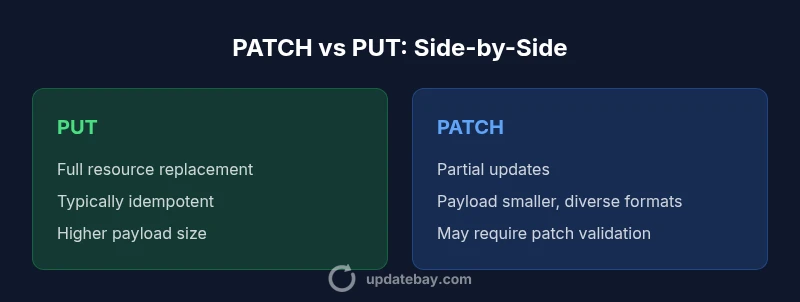
At a high level, the difference between a patch and a put in REST APIs is how the update is applied: PUT replaces the entire resource, while PATCH modifies only the parts that change. This distinction affects idempotence, payload size, and error handling. Understanding these semantics helps API designers choose endpoints that align with client needs and data integrity.
Definition and scope of PATCH vs PUT
In RESTful APIs, HTTP methods PATCH and PUT express distinct intentions for modifying resources. The difference between a patch and a put lies in how updates are applied: PUT typically replaces the entire resource with the payload supplied by the client, whereas PATCH applies a set of changes to a resource, leaving unspecified fields intact. This distinction matters for consistency, bandwidth, and data integrity. According to Update Bay, many teams adopt PATCH for incremental changes and PUT for full replacements, depending on resource size and update frequency. Understanding these semantics helps developers design endpoints that minimize conflicts and improve client-server coordination. In practice, PATCH can be implemented via JSON Patch, JSON Merge Patch, or custom patch formats, while PUT expects a complete representation of the resource state. This block sets the stage for deeper comparison and concrete guidelines across common API scenarios.
wordCountInBlock":null},null,
Comparison
| Feature | PUT | PATCH |
|---|---|---|
| Payload semantics | Full resource replacement | Partial updates to specific fields |
| Idempotence | Typically idempotent if the full-resource is provided | Idempotence depends on patch payload and server implementation |
| Typical use cases | Full replacement of a resource | Incremental updates and minimal payloads |
| Error handling | Conflict and validation errors for full replace | Validation and partial conflict handling |
| Concurrency control | ETags and version checks are common for PUT | ETags and version checks with patch can be used as well |
Positives
- Clear semantics for full replacement and easy reasoning about state
- Patch reduces bandwidth by updating only changes
- Supports progressive API evolution without forcing full payloads
- Better compatibility with stateless clients and caches
Downsides
- Patch formatting can vary (JSON Patch vs JSON Merge Patch) and lacks universal standardization
- Partial updates introduce more complex validation and potential partial failures
- PUT can incur higher network usage due to full payloads and larger payloads
Put for full resource replacement; Patch for partial updates.
For most RESTful APIs, use PUT when clients replace the entire resource and PATCH when updating only certain fields. Combine with proper validation and concurrency controls to prevent drift and conflicts.
Frequently Asked Questions
What is the difference between PATCH and PUT in REST APIs?
PUT replaces the entire resource with the supplied payload, while PATCH applies a set of changes to the resource, updating only the specified fields. The difference between_PATCH_and_put_ affects payload size, idempotence, and how conflicts are resolved.
PUT replaces the whole resource; PATCH updates parts of it. The choice changes payload size and how you manage conflicts.
When should I use PATCH instead of PUT?
Use PATCH when you want to update only specific fields rather than sending the full resource. This reduces bandwidth, improves performance for large resources, and aligns with incremental change patterns often seen in modern APIs.
Choose PATCH for partial updates to save bandwidth and support incremental changes.
Can PATCH be used to create resources?
PATCH can be used to create resources in some APIs with a patch that includes a creation operation, but this is not universal. Most designs reserve creation for POST or PUT, depending on whether the resource exists beforehand.
PATCH can create in some APIs, but not universally; check your API's spec.
Is PATCH idempotent?
Patch idempotence depends on the patch format and server handling. Some PATCH operations are idempotent if they describe deterministic changes, while others may not be. Use idempotent patch designs when possible to simplify retries.
Idempotence in PATCH varies by patch design; aim for deterministic updates.
How do JSON Patch and Merge Patch differ?
JSON Patch expresses changes as a sequence of operations (add/replace/remove). JSON Merge Patch provides a simple map of fields to update. Both follow PATCH semantics but have different complexity and tooling requirements.
Two common PATCH formats: JSON Patch uses operations; Merge Patch uses a field map.
What status codes are common with PATCH requests?
Typical codes include 200 or 204 on success, 400 for invalid input, 409 for conflicts, and 422 for semantic validation errors. The exact codes depend on your API’s error model and patch implementation.
Expect 200/204 for success, 4xx for errors, depending on your API.
How should I design APIs to support both PATCH and PUT?
Document the intended semantics for each method, provide clear error messages, and consider offering PATCH for partial updates with full-replacement PUT where appropriate. Use consistent versioning and concurrency controls across both methods.
Document semantics clearly and keep concurrency controls consistent.
What to Remember
- Define clear semantics for each method at the API boundary
- Prefer PATCH for partial updates to minimize payload
- Prefer PUT for full resource replacements
- Use ETags/optimistic locking for concurrency
- Test idempotence and failure modes for both methods
- Document the exact patch format you support