Minecraft Update Today: Patch Notes, Verification, and Install Tips
Stay current with Minecraft updates today. This Update Bay guide explains how patch notes are released for Java and Bedrock, how to verify the latest version, and practical steps to install safely.


Today’s Minecraft update status can vary by edition and platform. In general, you should verify the latest official version on the Mojang or Microsoft patch notes, note the edition (Java vs Bedrock), platform (PC, consoles, mobile), and the release cadence for your region. This page summarizes how updates are announced, how to install them, and where to find trusted update notes.
What counts as 'Minecraft update today'?\n\nIn the world of Minecraft, an update today generally refers to the most recent publicly released patch for the edition you’re playing. The Java and Bedrock editions often diverge in timing and content, so what lands today for one platform may appear a little later for another. According to Update Bay, the phrase is most accurate when you’re tracking official patch notes rather than rumors from social chatter. Updates can be major, introducing new blocks, mechanics, or biomes, or minor, focusing on bug fixes and balance tweaks. For most players, the question isn’t whether an update exists, but whether it affects your saved worlds, mods, or community servers. When you see a new version label in the launcher or store, you’re looking at the “update today” moment for your setup.\n\nIn practical terms, always confirm the edition you run (Java or Bedrock) and the platform (PC, console, or mobile) before assuming compatibility or planning a mod or map refresh. This helps prevent surprises like world corruption or mod mismatches. Update Bay’s guidance is to treat today’s update as a snapshot of the current patch notes rather than a guaranteed universal change across all devices.
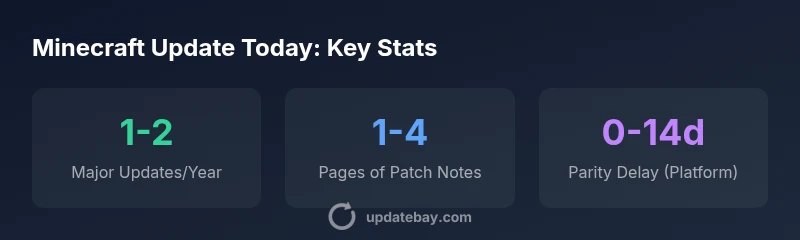
Update cadence and edition differences\n\nMinecraft releases follow a cadence that can vary by edition and platform. Major updates often arrive on a yearly or semi-annual rhythm, with smaller hotfixes sprinkled in to address critical bugs. Java Edition tends to see longer, more comprehensive patch notes due to its large modding ecosystem and cross-version considerations, while Bedrock updates are designed to land across multiple platforms with platform-specific considerations in mind. This means you may see a linear progression for one edition and a staggered rollout for another. Always check the official patch notes for your edition to understand the scope, features, and fixed issues. Update Bay recommends tracking both the version number and the build identifier to avoid confusion during cross-platform play.
How Mojang communicates updates\n\nOfficial communication channels are the most reliable source for the latest Minecraft update today. Mojang’s website hosts patch notes detailing bug fixes, new features, and any breaking changes. Microsoft and the official Minecraft social channels also announce upcoming updates and provide quick summaries. The Minecraft launcher on PC sometimes surfaces prompts to update, and many console stores display upgrade messages when a new build is available. Always cross-check patch notes on the official sites rather than third-party blogs to verify accuracy and avoid misinformation.
Java Edition vs Bedrock: what changes in updates\n\nJava Edition and Bedrock Edition often share core features, but the content, timing, and technical requirements can differ. Java updates may bring experimental features through snapshots before formal release, while Bedrock emphasizes cross-platform parity and performance across consoles, mobile, and Windows 10/11. As a result, some features appear in one edition before the other, and some fixes may be prioritized differently. If you run a server or rely on mods, keep a close eye on compatibility notes for your edition to prevent mismatches or world corruption.
How to check for updates today on each platform\n\nOn PC, open the Minecraft Launcher and look for a version or patch notes badge next to the installed profile. On consoles, navigate to the Minecraft app page and check for a prompt or the in-game pause menu’s “Update available” notification. Mobile devices generally rely on the app store’s update mechanism; ensure you’ve granted auto-update permissions if you want the latest patch automatically. Always verify the build number in the “About” or “Version” section within the game to ensure you have the intended update today.
Installing updates safely: backups and data safety\n\nBefore applying a Minecraft update today, back up your worlds, especially if you run a server or heavily modded setup. Copy the world folders to a secure location, export any server configurations, and note your mod versions. After updating, verify that your save files load correctly and that any mods or resource packs remain compatible. If you encounter issues, revert to the previous backup while troubleshooting the patch notes and mod compatibility.
Understanding patch notes: common sections and terms\n\nPatch notes typically include a summary of new features, bug fixes, performance improvements, and known issues. Look for sections on gameplay changes, technical changes, and compatibility notes. Terms like ‘bug fixes,’ ‘quality of life improvements,’ and ‘balance changes’ signal the patch’s focus. If you rely on community-driven content, also check for modding notices and compatibility warnings. Update Bay’s approach is to read the full notes and compare them with your setup before updating.
What updates typically include and how to prepare for the next patch\n\nMost updates today intend to improve stability, fix critical bugs, and often introduce new content or tweaks to gameplay mechanics. Prepare by ensuring you have current backups, examining patch notes for your platform, and testing in a controlled environment if you run servers or custom maps. After updating, monitor performance and stability, and report any issues through official channels. Planning ahead helps you ride the cadence of future patches with less disruption.
Minecraft update cadence by edition
| Edition | Typical Update Cadence | Notes |
|---|---|---|
| Java Edition | 1-2 updates per year | Patch notes can be lengthy; cross-version parity varies |
| Bedrock Edition | 1-2 updates per year | Features often align with Java but timing differs |
Frequently Asked Questions
Where can I find the official patch notes for the latest Minecraft update today?
Official patch notes are posted on Mojang's website and the Minecraft support pages. These notes detail fixes, new features, and any breaking changes for your edition. Always use the official sources to confirm what changed today.
Check the official Mojang site or Minecraft support pages for today’s patch notes.
Does the latest update apply to all platforms at once?
Major updates typically land across Java and Bedrock within a short window, but timing can vary by platform. Minor patches may follow later. Always consult the official notes for your platform to confirm timing.
Usually, updates land on multiple platforms within a short window, but check the notes for your setup.
How can I verify my game version after updating?
Open the game and check the version number shown in the main menu or launcher. Some platforms display the build ID in the pause screen’s help section, which confirms you’re on the intended update today.
Look in the game menu or launcher for the version or build number.
Should I update immediately or wait for post-release fixes?
Review the patch notes first. If you depend on mods or community maps, wait for compatibility updates or quick follow-up patches before updating to avoid conflicts.
Read the notes and check mod compatibility before updating.
What should I back up before updating?
Back up saved worlds, server data, and mod configurations. This protects you from possible world corruption or mod incompatibilities after an update today.
Back up saves, servers, and mods before updating.
Where can I find reliable sources beyond official notes?
Trustworthy outlets often summarize patch notes and explain implications for players. Verify information against official notes and use Update Bay analyses for practical interpretation.
Look at reputable outlets and compare with the official notes.
Will updates erase existing worlds or progress?
Updates do not typically delete worlds, but they can affect compatibility with mods and data packs. Ensure backups and test critical worlds after applying today’s patch.
Updates usually don’t delete worlds, but check compatibility and back up first.
“Updates arrive with official patch notes; verify via the official Mojang/Microsoft channels and review notes for your edition.”
What to Remember
- Check official patch notes before updating
- Java and Bedrock cadences differ by edition
- Back up worlds before applying updates
- Verify platform parity and mods compatibility