Driver's Licence Address Update: A Practical How-To
Learn how to update your address on your driver’s licence with a clear, step-by-step guide. It covers required documents, methods, timing, and practical tips for a smooth update.


To update your address on a driver’s licence, gather proof of your new address, choose an update method (online, in person, or by mail), fill out the form with your new address, and submit the documents. Expect a short processing period, and confirm the change once you receive confirmation.
Why updating your address on your drivers licence matters
Moving to a new home triggers several administrative tasks, and updating your address on your driver’s licence is a central one. A current address ensures you receive important notices about renewals, recalls, and traffic-related updates. It also helps authorities verify your identity when you’re pulled over or asked to present your licence. According to Update Bay, keeping your identity records accurate reduces risk of delays and mismatches across multiple government databases. Staying proactive with address updates can prevent issues with photo ID validity, insurance communications, and voter registration. In short, an accurate address keeps your records synchronized, minimizes travel friction, and supports smoother interactions with law enforcement, licensing agencies, and service providers.
Keep in mind that the exact requirements and timelines vary by jurisdiction. The information here is designed to give you a solid, practical framework no matter where you live, with pointers you can verify on your local DMV or licensing authority website.
Timing and when you should update
Most regions expect new residents to update their address promptly after a move, ideally within a defined window. The exact deadline differs by jurisdiction, so you should consult your local licensing authority to confirm. Proactively updating your address helps you avoid missed renewal notices and potential penalties for outdated records. If you move internationally or frequently relocate, you may want to set up a reminder in your calendar and check for any additional record updates that may be necessary in subsequent weeks. The Update Bay team recommends treating address updates as a standard post-move task rather than an optional chore, to keep all government records aligned with your current residence.
Note that some agencies allow online submissions and offer temporary digital licences while you wait for a formal update. Always verify whether any temporary documentation can stand in for your physical licence during the processing period.
Documents you’ll typically need
Requirements vary by jurisdiction, but most updates require proof of address and identity. Acceptable proofs of address include utility bills, bank or credit card statements, government correspondence, lease or rental agreement, or a government-issued document showing your name and current address. You may also need a primary form of photo ID (driver’s licence, passport, or national ID). If you’re updating by mail, ensure all copies are clear and legible, and that your originals are ready to present if requested. Some regions require additional documents for identity verification or name changes.
Tip: Prepare both physical copies and high-quality scans of your documents. This gives you flexibility to submit online or by mail and helps prevent delays caused by missing pages or unclear scans.
Online, in-person, or mail: choosing your method
Online updates are the most convenient for many people, letting you submit forms and upload documents from home. In-person visits can speed up verification, especially if extra identity checks are required. Mail submissions may be appropriate if you don’t have reliable internet access or if you need to provide notarized documents. Each method has trade-offs: online updates tend to be fastest but require digital copies, in-person visits require time and travel, and mail can add processing time. Consider your own schedule, access to documents, and the issuing authority’s options when deciding which path to take.
For some jurisdictions, you may need to present original documents in person to complete the update. If you’re changing multiple records (insurance, vehicle registration, voter registration), an in-person visit could be a single-stop option to streamline the process.
Step-by-step overview of the process
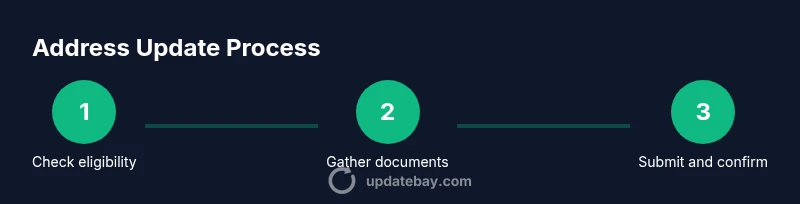
Below is a high-level roadmap to get you started. The detailed, step-by-step instructions appear later in the article, but this overview helps you plan your approach and gather what you’ll need. Start by confirming your jurisdiction’s requirements, then prepare your documents, choose a submission method, complete the address form, attach proofs, submit, pay any fees, and finally verify that the update is reflected across all records. Keep copies of everything as you go, and note any reference numbers for tracking.
If you prefer a visual guide, you can also consult a short video tutorial that walks through the same steps.
Common mistakes and how to avoid them
Rushing the process can lead to mistakes that delay your update. Common errors include submitting outdated proofs of address, using cleared scans that are unreadable, or failing to notify all relevant agencies (driving licence, vehicle registration, insurance, and voter registration). Double-check all names, addresses, and dates on documents before submission. If your jurisdiction requires an in-person visit, don’t skip the ID verification step. Always ensure the address on your licence matches the address listed on your bank statements or utility bills to avoid mismatches in government databases.
Tip: Create a simple pre-submission checklist and verify each item as you go. This reduces return trips and speeds up processing.
After you submit: tracking and confirming the update
Once you’ve submitted your update, you’ll usually receive a confirmation number or tracking status. Keep this information handy and check back periodically to monitor progress. If processing takes longer than the typical timeframe, contact the licensing authority with your reference number and any required documents. After approval, review other records tied to your address (insurance, voter registration, vehicle registration) to ensure consistency. Some agencies allow you to download a temporary digital licence while the update is pending; if so, carry it with you during travel or official processes.
Proactive follow-up helps prevent gaps between your physical licence and your current address.
Privacy and security considerations when updating personal records
Your address is highly sensitive personal information. Only use official government portals or in-person channels to submit data, and avoid sharing copies of documents on insecure sites. When submitting electronically, ensure the connection is secure (look for https and a lock symbol in the browser bar). Store digital copies safely and shred any physical documents you no longer need. If you notice suspicious activity after submitting personal data, contact the licensing authority immediately and consider placing a temporary fraud alert with credit bureaus if available.
Cross-linking updates with other records (vehicles, insurance, voting)
Address changes typically affect multiple records. After updating your driver’s licence, it’s prudent to update your vehicle registration, insurance policy, and voting registration to reflect the new address. Some jurisdictions allow you to update several records in one session, while others require separate submissions. Maintaining alignment helps prevent notices, policy mismatches, and eligibility issues for voting. Keep a centralized log of all changes and confirmations to simplify future updates.
Tools & Materials
- Proof of address documents(e.g., utility bill, bank statement, government correspondence dated within the last 3 months)
- Photo ID(A government-issued ID with your name)
- Identity documents(e.g., passport or national ID card)
- Digital copies (scans)(PDF or image scans of documents)
- Printer/Scanner(If submitting by mail or making copies)
Steps
Estimated time: 30-60 minutes
- 1
Gather required documents
Collect proof of address and your primary photo ID. Ensure documents are current and legible. Having both originals and copies ready speeds submission.
Tip: Use a dedicated folder to organize documents before you start. - 2
Choose submission method
Decide whether to update online, in person, or by mail based on availability and your schedule. Online is usually fastest but may require scanned copies.
Tip: If you can visit in person, you may speed up identity verification. - 3
Fill out the address form
Enter your full, current address exactly as it should appear on all records. Double-check for typos and ensure it matches your proofs.
Tip: Copy/paste the address from official documents to avoid mistakes. - 4
Attach proofs of address and identity
Upload or attach copies of your documents. Ensure each file is readable and clearly labeled with the document type.
Tip: Name your scans clearly, e.g., 'Utility_Bill_Jan2026.pdf'. - 5
Submit and pay any fees
Submit the form and make any required payment. Retain the payment confirmation or receipt for your records.
Tip: If a payment option fails, try a different method or contact support. - 6
Confirm submission status
Check the submission status in the portal or via your confirmation email. Look for a tracking number or reference.
Tip: Set a reminder to check status within a week if processing isn’t immediate. - 7
Receive confirmation of update
You’ll usually get a confirmation that the update is approved. Review the details for accuracy and keep the confirmation for your records.
Tip: Print or save a digital copy of the final confirmation. - 8
Update other records
Log into or contact related agencies to update vehicle registration, insurance, and voting records as needed.
Tip: Use a single checklist to track all records updated. - 9
Verify all records reflect the new address
After submissions are processed, verify that your address appears correctly on your driver’s licence and linked documents.
Tip: If something looks wrong, contact the agency promptly with your reference numbers.
Frequently Asked Questions
Do I need to update my address within a certain timeframe after moving?
Most jurisdictions require updating after moving, but deadlines vary by region. Check your local DMV or licensing authority for specifics.
Most regions require updating after moving, but deadlines vary. Check your local DMV for exact timing.
What documents count as proof of address?
Proof of address typically includes documents showing your name and current address, such as a utility bill, bank statement, government correspondence, or lease agreement. Requirements vary by jurisdiction.
Proof of address usually includes documents showing your name and current address, like a utility bill or lease.
Can I update my address online?
Online updates are common in many regions, but some places require in-person verification for identity. Visit your local DMV website to confirm available options.
Online updates are common, but some places require in-person verification. Check your local DMV site.
Is there a fee for updating the address?
Many jurisdictions charge a small processing fee for address changes. Fees and payment methods vary by region.
There is usually a small processing fee; payment methods vary by region.
How long does it take for the update to reflect?
Processing times vary; some updates are immediate online, while others take days to weeks by mail or in-person.
Processing times vary; some updates are immediate online, others take days by mail or in person.
What should I do if online submission fails?
If online submission fails, try again later, switch to in-person or mail submission, and contact the issuing agency for help.
If online submission fails, retry or switch to in-person or mail, and contact the issuing agency.
Watch Video
What to Remember
- Gather documents before starting
- Choose the right submission method for you
- Keep confirmation receipts and track status
- Update other records after your licence change
- Protect personal information during the process