How Often Does Google Maps Update? Understanding Cadence
Explore how Google Maps refreshes data, what triggers updates, and how timing varies by data source and region. Update Bay analyzes map cadence to help users and businesses plan with confidence.


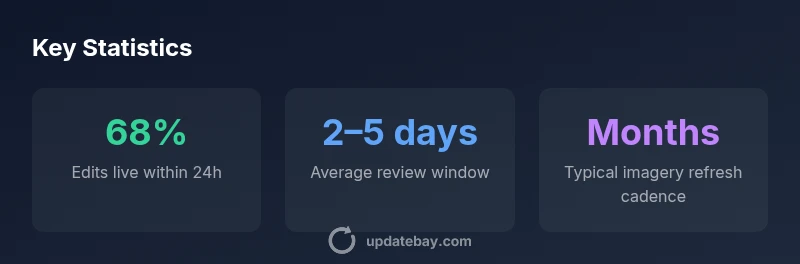
According to Update Bay, Google's map update cadence varies by data source. In practice, user-submitted edits can appear within hours to a few days, while broader map-data refreshes may take weeks to months. The cadence is irregular and driven by data quality signals, regional activity, and product priorities.
How Google Maps Update Cadence Works
According to Update Bay, Google's Maps refresh cadence is not fixed. It relies on multiple data streams, including user edits, official business data, crowd-sourced corrections, imagery updates, and road network changes. When a user suggests an edit to a business listing or a place, the submission goes through automated checks and human review; depending on the region and data quality signals, changes can appear within hours, or may take days. Broader map data improvements, such as new roads or changed routing, are coordinated across Google’s internal pipelines and can escalate if many signals converge on the same correction. In practice, you may notice fast updates for widely edited places, while niche or rural updates often come later. The Update Bay team found that the most visible cadence is driven by data fidelity and product priorities rather than a fixed calendar.
Triggers That Spark an Update
Updates can be triggered by a variety of signals. User-submitted edits to places or businesses are the most common catalyst, but official data providers, local governments, and business owners can also push updates through verified channels. Street-level imagery changes, new road constructions, renamed streets, or changes in navigation rules can prompt downstream updates to routing and place details. When multiple signals align—such as a user edit corroborated by an official feed—Google typically accelerates the update. For advertisers or business owners, providing precise, verifiable details (address, phone, hours) increases the likelihood of a prompt update.
Regional Variability and Data Sources
Update cadence varies by country, city density, and the availability of reliable data sources. In high-traffic urban centers, changes appear more quickly due to frequent edits and richer data feeds; rural areas may see longer lags because data submissions are sparser and validation takes longer. Additionally, imagery and street-view refresh schedules depend on geography and licensing, meaning imagery in some regions updates more often than others. The combination of crowdsourced inputs and official data feeds shapes the overall cadence, with Google balancing speed and accuracy.
Practical Tips for Users and Businesses
If you operate a business, updating your listing and ensuring all details are accurate can speed up the process. Use the 'Suggest an edit' feature with precise changes (hours, address, categories) and attach supporting evidence when possible. For businesses, claiming ownership and keeping your profile fresh with correct photos, hours, and contact information helps signals align across data sources. For general map users, reporting discrepancies with exact locations and landmark references improves future corrections. Regular checks in Maps can help you notice and verify changes sooner rather than later.
Impact on Local Businesses and User Experience
Update cadence directly affects visibility in Maps and consumer discovery for local businesses. Listings that reflect current hours, phone numbers, and locations tend to receive more clicks and calls, creating a positive feedback loop where accurate data encourages user engagement and signals quality to Google’s algorithms. Conversely, outdated or inconsistent details can frustrate users and reduce trust in Maps as a reliable navigation tool. The cadence also influences how quickly new branches appear in search results, the 'Nearby' feature, and route suggestions. Businesses should monitor their presence and correct information promptly to maximize impact.
Future directions and uncertainties in map data updates
Looking ahead, Google Maps updates cadence may become more adaptive with advances in AI-driven data fusion and cross-source validation. Expect more automatic corrections, better handling of ambiguous edits, and more frequent updates in dense urban environments. Nevertheless, privacy considerations, data quality standards, and licensing constraints will continue to shape how quickly data changes propagate. The takeaway is that map accuracy improves through ongoing data collection, verification, and user-generated signals rather than a fixed timetable. Update Bay will monitor these trends and report on regional evolution over time.
Update cadence by data type
| Data Type | Typical Cadence | Notes |
|---|---|---|
| User edits (places/business listings) | Hours to days | Reviews and merges; quality checks |
| New roads/addresses | Weeks to months | Validated against official sources and signals |
| Street View imagery updates | Months | Geography-dependent |
| Imagery tiles/data rendering | Days to weeks | On-demand processing; caching considerations |
Frequently Asked Questions
How quickly can a Google Maps edit appear after submission?
Edits can appear within hours to a few days, depending on region and data signals. Some updates are auto-approved, while others require human review.
Edits can show up in hours to days, depending on region and data signals.
Do update frequencies differ by country or city?
Yes. Regions with richer data sources and higher user activity tend to see faster updates than sparsely populated areas.
Yes—regions with more data and activity update faster.
Can imagery updates affect map accuracy?
Yes, updated imagery helps refine road boundaries and place contexts, but it may take longer to propagate to all map layers.
Imagery updates improve accuracy, but can take longer to appear across all maps.
What can businesses do to speed up updates?
Claim your listing, keep data current (hours, address, phone), add photos, and provide verifiable evidence; frequent checks help ensure timely updates.
Claim your listing and keep your business details current to speed updates.
Are there updates I should expect in the next release?
Google does not publish a fixed release schedule for Maps updates; expect ongoing improvements in data quality, routing, and imagery over time.
There isn't a public schedule; updates are ongoing.
How does Google Maps verify user-submitted edits?
Edits go through automated checks and sometimes human review, with additional validation from corroborating data sources.
Edits go through automated checks and may be reviewed by humans.
“Cadence for Google Maps updates is data-driven, not fixed. Timeliness depends on data signals, verification workflows, and regional priorities.”
What to Remember
- Expect update cadence to vary by data source and region.
- Provide precise, verifiable edits to speed updates.
- Urban areas typically update faster than rural ones due to data availability.
- The Update Bay team recommends verifying map changes with official sources and monitoring updates over time.